8. Pamukkale, Turkey
Advertisement
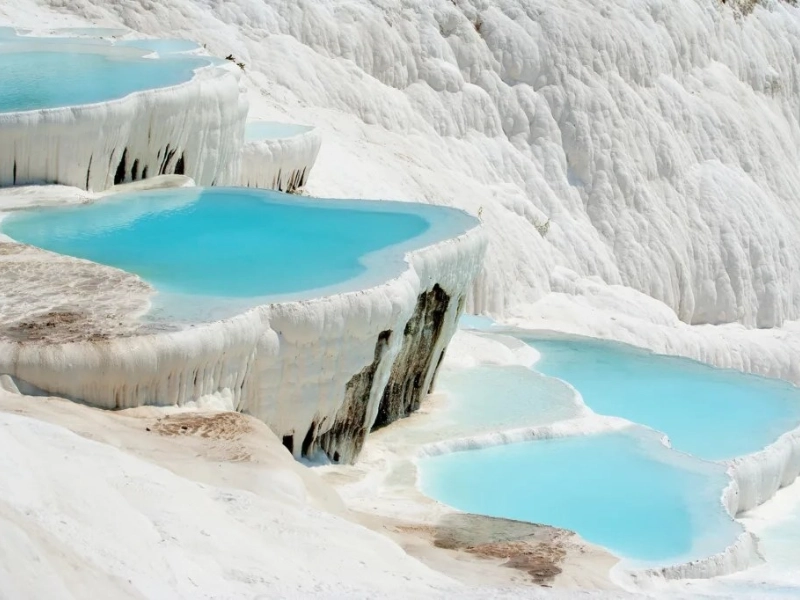
Translating as "Cotton Castle" in Turkish, Pamukkale is a natural wonder in Denizli Province in south-west Turkey. Renowned for its brilliant white travertine terraces created over millennia by thermal springs high in calcium carbonate, this remarkable environment Since 1988, the site—which includes the nearby ancient city of Hierapolis—has been a UNESCO World Heritage Site drawing millions of people each year to marvel at its unusual geological formations and soak in its healing waters.Pamukkale's famous terraces arise from a delicate interaction among geology, chemistry, and time. The process starts well below ground, where volcanic activity heats fluids high in calcium. These mineral-carrying fluids cool and release carbon dioxide as they surface. Calcium carbonate precipitates under this process to create travertine, a kind of limestone. This ongoing deposition over thousands of years has produced a cascading sequence of terraces resembling a frozen waterfall or, as their name implies, a cotton castle.About 2,700 metres (8,860 feet) in length, 600 metres (1,970 feet) in width, and 160 metres ( 525 feet) in height Pamukkale's terraces cover. The travertine's extreme white hue stands out sharply against the surrounding terrain, producing an almost surreal visual spectacular. The terraces are always changing as the mineral-rich streams keep flowing and depositing calcium carbonate, not only stationary structures.From ancient times, the medicinal qualities of the thermal springs feeding the terraces have been prized. Rich in minerals including calcium, magnesium, bicarbonate, and sulphur, the water, which comes out at about 35°C (95°F), is Particularly for persons with rheumatism, skin ailments, and circulation difficulties, these minerals are thought to have therapeutic properties. Recognising the importance of these waters, the ancient Romans founded the therapeutic centre Hierapolis near the springs.Founded in the second century BCE, Hierapolis grew into a bustling spa city governed by Romans. Besides the travertine terraces, the remnants of this ancient city offer an intriguing historical background for Pamukkale's natural beauties. Visitors can investigate the astonishingly intact theatre, temples, a necropolis, and well-preserved Roman bath remnants. Offering a unique experience combining natural beauty with historical immersion, the Antique Pool—also known as Cleopatra's Pool—allows modern-day guests to swim among ancient Roman columns dropped into the thermal waters following an earthquake.Pamukkale has ecological relevance outside of its geological formations. The location maintains a special ecosystem suited for the mineral-rich, warm seas. Many different kinds of plants and bacteria flourish in this surroundings, therefore supporting the local biodiversity. Pamukkale is a significant location for ecological study since the terraces and pools generate a sequence of microhabitats with unique traits and occupants.But Pamukkale's appeal as a travel destination has created major preservation difficulties. Unrestricted construction and access once threatened the delicate equilibrium of the travertine terraces. Hotels constructed on the site diverted thermal waters for personal use, leading to browning of some of the terraces and dry-out of others. Reacting to these dangers, Turkish authorities tightened conservation policies in the 1990s. Hotels were destroyed, and a new mechanism was built to guarantee the even dispersion of thermal waters over the terraces. To reduce erosion and contamination, visitors must now take off their shoes before traversing the travertine.Pamukkale's natural beauty has been mostly preserved by these conservation initiatives, which also let sustainable tourism be possible. The location is now a model for striking a balance between public access and preservation, showing how tourism can help local businesses economically while nevertheless safeguarding natural beauties.Pamukkale has scientific worth beyond only its outward characteristics. The site offers scholars understanding of travertine formation processes, geochemistry of thermal springs, and long-term consequences of mineral deposition on landscapes. Research done at Pamukkale advance our knowledge of similar geological processes globally and guide conservation plans for other travertine formations.The fragile equilibrium of Pamukkale's ecology might be threatened by climate change. Variations in temperature and precipitation could influence the flow and mineral concentration of the thermal springs, therefore influencing the rate and kind of travertine production. Development of adaptive management plans to guarantee the long-term protection of this special site depends on constant observation of these changes.Pamukkale is also really important culturally. For millennia, it has been a site of spiritual meaning and healing for different societies. For Turkey today, it still reflects the nation's rich natural and historical legacy as well as a cause of national pride. The site's listing on the UNESCO World Heritage list acknowledges not only its geological distinctiveness but also its cultural importance and the need of preservation for next generations.Pamukkale is ultimately evidence of the remarkable beauty resulting from the geology of Earth. Formed over millennia by mineral-rich thermal springs, its brilliant white terraces create a scene nearly too flawless for natural occurrence. The place is quite special because of its mix of medicinal waters, old history, and geological beauties. Pamukkale reminds us of the need of conserving our natural beauties while we confront worldwide environmental problems. In addition to being amazing spectacles, they are priceless tools for scientific research, cultural legacy, and knowledge of the fragile equilibrium of the ecosystems on Earth. The continuous attempts to sustainably manage Pamukkale provide hope and lessons for the protection of other natural beauties all throughout the globe.
Advertisement