5. Wai-O-Tapu, New Zealand
Advertisement
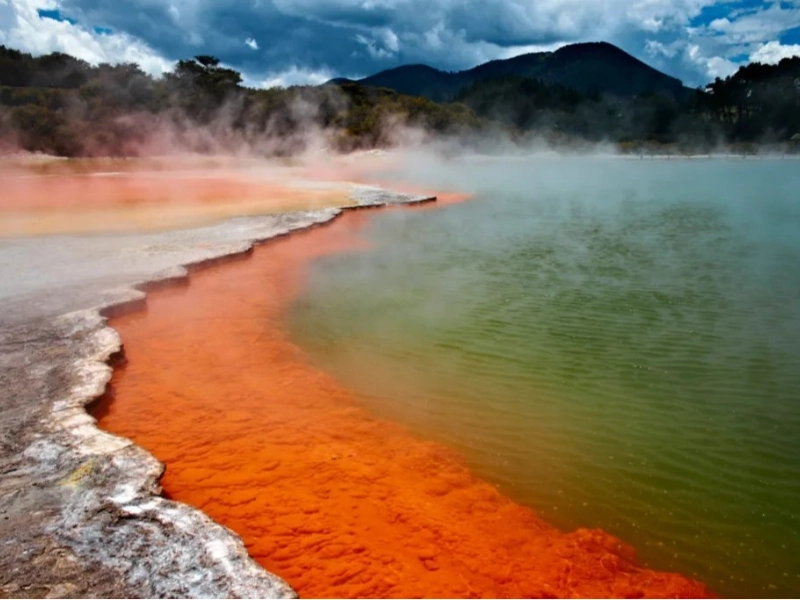
Found in the Taupo Volcanic Zone on New Zealand's North Island, Wai-O-Tapu—meaning "Sacred Waters" in Māori—is a geothermal marvel. Renowned for their brilliantly vivid and varied geothermal characteristics, this region is among the most strange and visually amazing settings on Earth. Covering almost 18 square kilometres (7 square miles), Wai-O-Tapu presents guests with an amazing trip across a palette of vivid colours, steaming lakes, bubbling mud pools, and unusual geological structures formed over thousands of years of strong geothermal activity.Wai-O-Tapu's appeal stems mostly from the well-known Champagne Pool, a hot spring that has come to represent New Zealand's geothermal beauties throughout. The pool gets its name from the copious carbon dioxide that makes the water effervesce, like a glass of champagne. Deposits of orpiment and realgar (arsenic sulphide minerals) produce a vivid orange ring for the Champagne Pool that contrasts sharply with the rich blue-green of its waters. Measuring over 65 metres in diameter and reaching a depth of up to 62 metres, this natural masterwork has water temperatures hovering about 74°C (165°F). Comprising a range of extremophile bacteria that flourish in its mineral-rich, very acidic waters, the pool is not only physically beautiful but also scientifically important.The Artist's Palette, a sequence of terraces and little hot springs exhibiting an incredible spectrum of colours, located next to the Champagne Pool. As geothermal fluids sweep over the surface, different minerals deposit these colors—from deep reds and oranges to brilliant yellows and greens. Presenting guests with a natural canvas that seems almost too vivid to be true, the Artist's Palette stands up to its name. Photographers and artists both will find an always shifting display created by the interaction of light, minerals, and geothermal activity fascinating.Wai-O-Tapu also boasts the Devil's Bath, a startling neon-green pool whose unearthly hue results from suspended colloidal sulphur particles and ferrous ions. The Devil's Bath's strong green colour is so artificial in look that many guests wonder whether it could possibly be a natural phenomena. This function reminds us sharply of the intricate chemical processes under Earth's surface and the amazing variety of geothermal expressions.Nestled inside the Wai-O-Tapu complex, the Lady Knox Geyser gives the geothermal experience some expected thrill. Though not a naturally erupting geyser, surfactant causes it to erupt daily at 10:15 AM, producing a column of water up to 20 metres (65 feet) into the air. Drawing throngs to see this amazing exhibition of geothermal power, this daily eruption has grown to be a popular destination.Additionally found in Wai-O-Tapu are other mud pools, each with special qualities. These pools range in kind from softly bubbling cauldrons to powerfully churning pits of hot mud. Originally the site of a sizable mud volcano destroyed by erosion in the 1920s, the Mud Pool today presents guests with an amazing show of boiling, steaming mud. These mud pools' constant motion and ever shifting patterns create a dynamic and mesmerising display that shows the area's continuous geothermal activity.Wai-O-Tapu's geothermal features are placed amid a terrain that has been drastically sculpted over thousands of years by volcanic and geothermal activity. Topography created by collapsed craters, steaming fumaroles, and large sinter terraces seems more extraterrestrial than terrestrial. Walking paths around the park let guests safely explore this special surroundings from vantage points highlighting the scope and variety of the geothermal activity.Wai-O-Tapu has scientific worth beyond only looks. Researchers examining geothermal processes, mineral production, and extremophile biology find a natural laboratory here. Many of Wai-O-Tapu's features offer insights on the boundaries of life on Earth and maybe on other worlds given their harsh conditions. Research carried out here have helped us to better grasp early Earth circumstances and the kinds of settings that might sustain life elsewhere in the universe.Maintaining this special habitat depends on efforts at conservation at Wai-O-Tapu. Human activity easily disturbs the delicate equilibrium of geothermal activity; so, steps have been taken to safeguard the region while still letting tourists to enjoy its beauties. While educational campaigns try to increase awareness of the need of preserving these natural events for next generations, boardwalks and designated viewing sites help minimise effect on the delicate ground.Wai-O-Tapu's cultural relevance to the Māori people gives the property still another level of value. For millennia, New Zealand's geothermal sites—used for cooking, bathing, and medicinal needs—have been vital to Māori life. Wai-O-Tapu's name itself captures the holy character of these waters per Māori custom. Efforts to include Māori viewpoints and expertise into the administration and interpretation of the site assist to maintain and distribute this rich cultural legacy.All things considered, Wai-O-Tapu is among the most visually striking and scientifically interesting geothermal sites in the world. Its combination of vibrant colours, varied geothermal phenomena, and unusual geological formations produces a scene that seems nearly too fanciful to be genuine. Wai-O-Tapu, a natural wonder, scientific resource, and cultural monument, never fails to astound us, encourage study, and deepen our knowledge of Earth's geothermal dynamics. Maintaining this remarkable natural occurrence as well as expanding our understanding of the intricate interaction among geology, chemistry, and biology in harsh conditions depend on its preservation and proper management.
Advertisement